Tomorrow, you're only a day away!
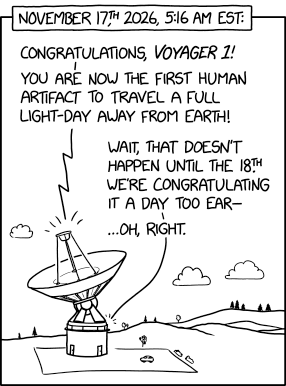
The Voyager 1 probe, launched 5 September 1977, is about to become the first human-made object to fly an entire light-day (86,400 light-seconds, about 25.9 billion km/Tm) from Earth. NASA officially estimates that this will happen at 10:16:07 UTC tomorrow, about 13 hours from now. But because it's so far away and moving so quickly relative to us, there's a wrinkle. Several wrinkles.
First, let's say Voyager sent out a time signal every second. At 10:16:07 tomorrow, we would receive a time signal from Voyager for 10:16:07 today.
Only, that's not quite right, because Voyager is traveling about 16.9 km/s, or about 61,000 km/h, relative to Earth. In one day Voyager travels another 1.46 million kilometers relative to us, which is about 4.87 light-seconds. So at 10:16:07 UTC tomorrow, we would receive a time signal from Voyager's clock saying 10:16:02 today.
See, Voyager is one light day away from Earth today based on the perception that things happen instantaneously. They don't; light speed is the arbiter of "now," and so Voyager will be one light day from us Thursday, at least based on the information we have from it.
Only, that's not quite right, because in our frame of reference, an object traveling at 16.9 km/s experiences a time dilation of about 1.59 nanoseconds per second, which adds up to about 50 milliseconds per year. After 49 years, assuming constant relative motion (which it didn't have), that would be 2450 milliseconds of dilation, so Voyager's time stamp should be 10:16:00.5 at the appointed hour.
Only, that's not quite right, because the farther an object gets from other masses, the faster its clock runs. Voyager is so far from the sun that the sun's gravity has almost no effect on it anymore. So Voyager is picking up about 440 milliseconds per year.
I didn't even get into the fact that Earth revolves around the sun faster than Voyager is departing the solar system.
Anyway, Voyager is very, very, very far away, and relativity is weird. It's been the human-made object farthest from the sun since February 1998, and it crossed the heliopause into interstellar space in August 2012.
XKCD:
Others have commented
David Harper
You're assuming, of course, that Voyager's on-board chronometer is still keeping perfect time in its own rest frame. Given that it was built using early 1970s technology, that's likely to be a quartz oscillator. It's been running for around 1.5 billion seconds, in the harshest environment into which we've ever sent a spacecraft (except perhaps for Parker Solar Probe), so if it's only out by five seconds, I would be quite surprised. Then again, it was built by a generation of JPL engineers who really knew what they were doing, so maybe I should have more faith.
David Braverman
I'm just amazed that it's sending back data at all. And that we can still see its signals, given how little power it has left and what the inverse-square law does with its emissions.
Copyright ©2026 Inner Drive Technology. Privacy. Donate!