After decades of taking the Piccadilly Line tube on every trip to London I've ever made, and after decades of snickering like a 13-year-old boy every time they announce where the eastbound train is actually going, I finally went there:
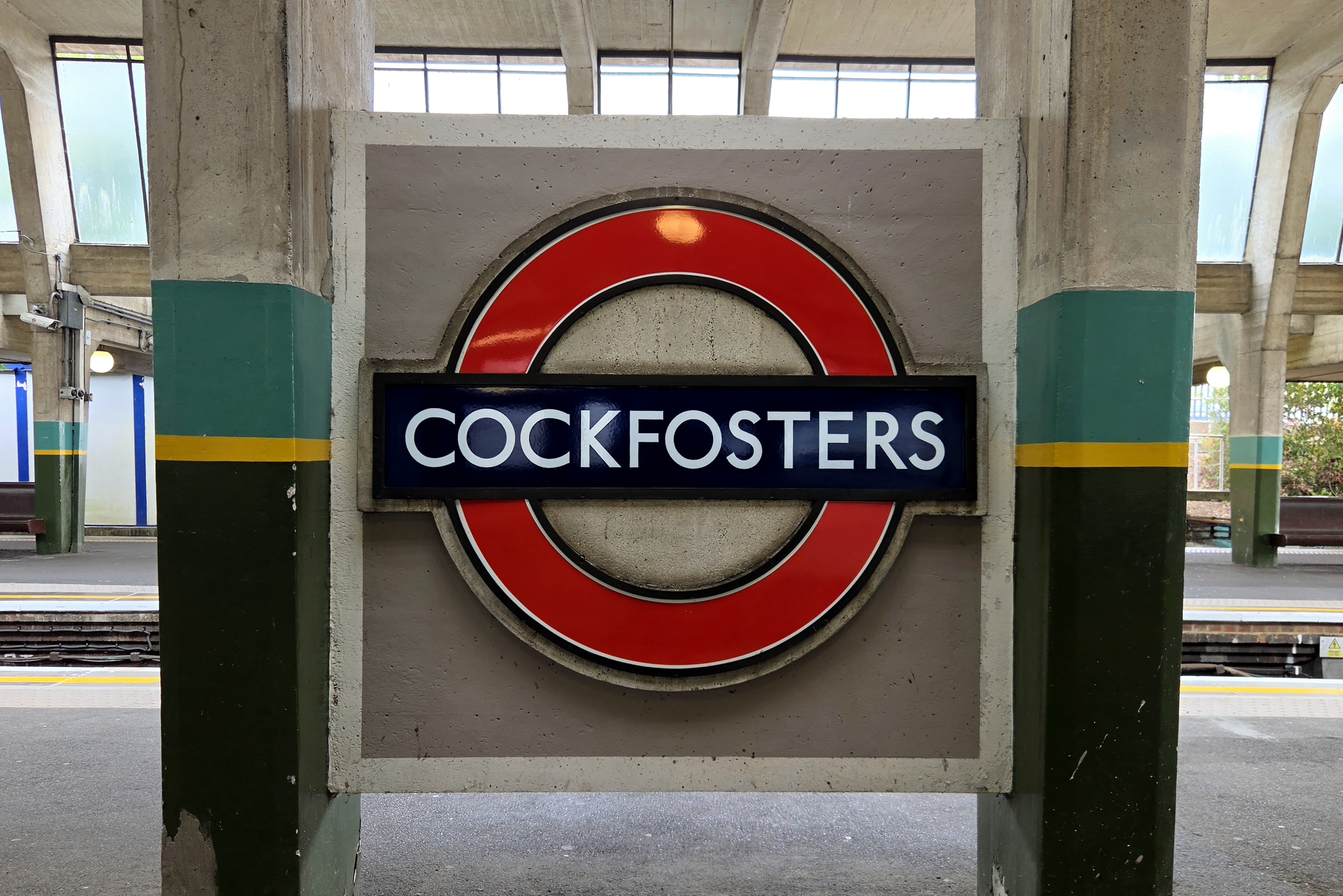
I then took a 5.7-km hike all the way to Barnet through an urban forest and past some of the nicest houses I've ever seen. There was also the bit where I saw two crows eating a pigeon alive, but we don't need to discuss that further.
And of course I wound up the day at the Southampton Arms, my favorite pub in the world. It did not disappoint.
I'm heading back home this afternoon, picking Cassie up this evening, and if things go well, I should be dead asleep by 9pm.
Pinned posts
- About this Blog (v5.0) 1 month
- Brews and Choos project 2 months
- Chicago sunrises, 2026 8 months
- Inner Drive Technology's computer history 2 years
- Logical fallacies 7 years
- Other people's writing 6 years
- Parker Braverman, 2006-2020 5 years
- Style sheet 1 year
- The 30-Park Geas 1 month
- Where I get my corn-pone 7 months
Having spent the past week in French-speaking countries, and having spent a lot of time preparing for the visit by learning as much French and French culture as my brain could hold, I got in the habit of saying "Bonjour" every time I walked into a shop, café, or really anyplace someone was working. (That, and "excusez-moi de vous déranger," "s'il vous plaît," and "non, absolument je n'ai pas voté pour ce putain d'espèce du clown, il y a encore des americains sains, en particulier lesquels qui parlent français et dire bonjour et s'il vous plaît.")
Saying "good morning" to random people is something one simply doesn't do in London. I said "good morning" to the person behind the counter at the local Prêt à Manger just now (desperate times, needing coffee before 8am on a weekend in London) and freaked her out. I would expect similar disblief at a Prêt or a Starbucks in Chicago or NYC as well. Fortunately one can get away with all kinds of inappropriate cheerfulness here if one has an American accent. In any event, I remembered where I was, said "sorry" in a sort-of sullen way, and all was back to normal for her.
I also noticed that Prêt now sells the orange-colored Lovecraftian obscenity known as "pumpkin spice." On behalf of the People of the United States, I apologize for all the orange-colored Lovecraftian obscenities my countrymen have thrust upon you recently, and I hope that somehow, in some small way, I can make amends today.
At the moment, however, I have an important meeting with some eggs, bacon, beans, mushrooms, and toast. And more coffee.
I have made it to London where I am now eating a delicious butter chicken from a local takeaway. I was going to go whole-hog1 and get kebab, but the curry place smelled so good, and I was pretty hungry.
The trip from Paris to London took 2:37, traveling for a good bit of the time close to 300 km/h (186 mph), which is 40 km/h (25 mph) faster than the fastest train in North America. Unfortunately today's Eurostar also traveled for a good bit of the time close to 75 km/h, which careful readers will realize is slower than 300. But we left 12 minutes late and arrived only 6 minutes late, so I guess those speed variations are normal.
On the other hand, the experience at Paris Gare du Nord trying to get on the Eurostar was not at all like the experience last Sunday getting on the Eurostar at London St Pancras. In both locations, you go through passport control, security, and a quick customs check, though Paris adds an exit passport check as well per Schengen rules. Still, from queuing up at St Pancras to getting into the holding area on Sunday took about 15 minutes. This afternoon, from getting into the queue to begin the process through getting onto the train, which involved another queue, was 45 minutes. The French blame Brexit, while anyone with eyes and a frontal lobe will blame the French. Gare du Nord's London-bound screening area is a marvel of architecture worthy of some of the Soviet Union's greats.
Anyway, I'm here now, the curry has been completely murdered (and dammit I want more), and now I need to get out of my hotel room2. More tomorrow.
-
Probably the wrong metaphor to describe halal food, especially on Rosh Hashana. The curry is halal, though not Kosher, because for some reason the commandment "do not cook a kid in its mother's milk" has been expanded to include butter chicken.↩
-
As much as I love the Continent, modern hotels are much easier to find in London than in small towns in Normady or Belgium (like Brussels). I was thinking about this as I walked the two paces from one end of my room to the other yesterday, how the US can't do transport, food, or education nearly as well as Northern Europe, but our hotels are way more comfortable.↩
Twenty five years later
I was here yesterday:

That seemed like the right place to be the day before the 25th anniversary of the 9/11 attacks. The men buried in that cemetery died to take freedom back from fascism. They decided, at all of 18 or 19 or 20 years old, that they wanted to live in a world where people like Hitler and Mussolini did not. And they succeeded.
Unfortunately, the impulses that give us dictatorship don't actually die; they're baked into how humans work. That's why we have to keep fighting against the people who want power and control, because they will keep trying to take it.
The 9/11 attacks gave those people a great excuse. When people like me (and, notably, Russ Feingold) were warning that the US response to 9/11 would be worse than the attacks themselves, we got shouted down. But we were absolutely right:
Six weeks after the terrorist attacks of Sept. 11, 2001, Congress passed the Patriot Act. The vote was 357 to 66 in the House and 98 to 1 in the Senate. Senator Russ Feingold, Democrat of Wisconsin, the chamber’s lone dissenter, said later that many of his colleagues hadn’t bothered to read it.
Some provisions had long been on the wish lists of federal law enforcement agencies, and it was not clear that the new powers would have prevented the attacks. They also cautioned that if history was any indication, the government would use the new powers primarily for routine law enforcement. They urged Americans to imagine those powers in the hands not of an altruistic and conscientious president, but one with little respect for norms, institutions or democratic principles.
Well, welcome to the worst-case scenario. We now have a president who is using the post-9/11 counterterrorism powers for his own ends.
The most ominous, if less obvious, change since the Sept. 11 attacks has been the extent to which Congress and the courts have retreated in the face of this 25-year executive-branch power grab. Congress has all but abdicated its authority to declare war and seems to have accepted a drastically diminished oversight role over American intelligence operations. The Supreme Court’s expansion of criminal and civil liability immunity was in itself a concession of its power to the executive.
In the years after Sept. 11, 2001, national security hawks were fond of the phrase “the Constitution is not a suicide pact.” That warning was always a canard. History teems with great states destroyed by autocrats and dictators. The threat to free societies has never been too much freedom. It has always been authoritarianism — and always will be.
The Patriot Act was the first evidence that the 9/11 terrorists were winning the long game. The OAFPOTUS's destruction of our alliances and soft power are what the terrorists dreamt of when they boarded those planes. But we can still prove them wrong, despite the last 25 years of creeping authoritarianism under color of "protection."
Authoritarianism is not inevitable; witness the last 80 years of Western civilization. But as Balko points out, government power tends to ratchet up, as the people who go into government are increasingly the people who want that kind of power. Still, history also shows that they always overreach, and at least in the past 400 years, they almost always lose—often with, unfortunately, a lot of damage to the rest of the world. I just hope enough Americans have seen the damage the OAFPOTUS has caused as the poster boy for concentrating power in the tiny hands of a moron that they'll support the real reforms I hope my party can push through in the '30s. We might just get through this round of authoritarianism with our democracy intact.
August tied the record for the hottest month ever recorded, both globally and in the oceans. The planet is getting warmer, thanks almost entirely to human activity:
August’s sweltering temperatures capped the warmest summer on record for both Western Europe and the contiguous United States. Across the lower 48 states, the average temperature last month was 24.2°C, the highest on record for August and 1.94°C above the 20th-century average, the National Oceanic and Atmospheric Administration said on Wednesday.
That made August the first month since last November when global warming exceeded 1.5°C, an important number in humanity’s efforts to curb climate change.
In related news, Singapore-based AlphaGeo ranked 72 of the world's largest cities on climate-change resiliency and put Chicago at the top of the list:
Chicago’s rank as the most “climate resilient” location was guided by the combination of its low physical exposure to a bevy of climate risks — inland flooding, coastal flooding, heat stress, drought, wildfires and hurricane winds — and the city’s high adaptation to those risks, including via infrastructure, early warning systems and policy responses.
“Chicago is the most resilient major city in this analysis, benefiting from low coastal and tropical hazard exposure combined with robust urban infrastructure,” the report found.
Chicago’s geography shields it from some of the most catastrophic natural disasters that affect coastal regions, like hurricanes and rising sea levels, the report noted.
No other U.S. cities made the list of the top 20 most resilient locations. Others in the top five include Addis Ababa, Ethiopia; Melbourne, Australia; Barcelona, Spain; and Ankara, Turkey. Many in the bottom of the rankings were cities in South Asia, the report said, although Phoenix, Ariz. was ranked the 17th least resilient city. Those cities faced the greatest heat exposure and relatively low adaption rates, the authors said.
I haven't read the report, so I don't know if it also mentioned that Chicago has about 44 km of shoreline with the second-largest body of fresh water in the world (when combined with Lake Huron), and the largest body of fresh water located entirely within one country. That will also help us as things get worse. And they are getting worse: the Illinois State Climatologist reported this week that Illinois set records for the most tornados in a year (just through July!) and the largest hailstone ever recorded in the state (168 mm, 557 g).
Before any of that happens, however, I will be spending a chunk of my day along the Normandy coast, imagining a time when most of the world united to destroy a fascist regime. Should be educational.
Now this is a classic budget European hotel, shown here with the air conditioning at full blast:
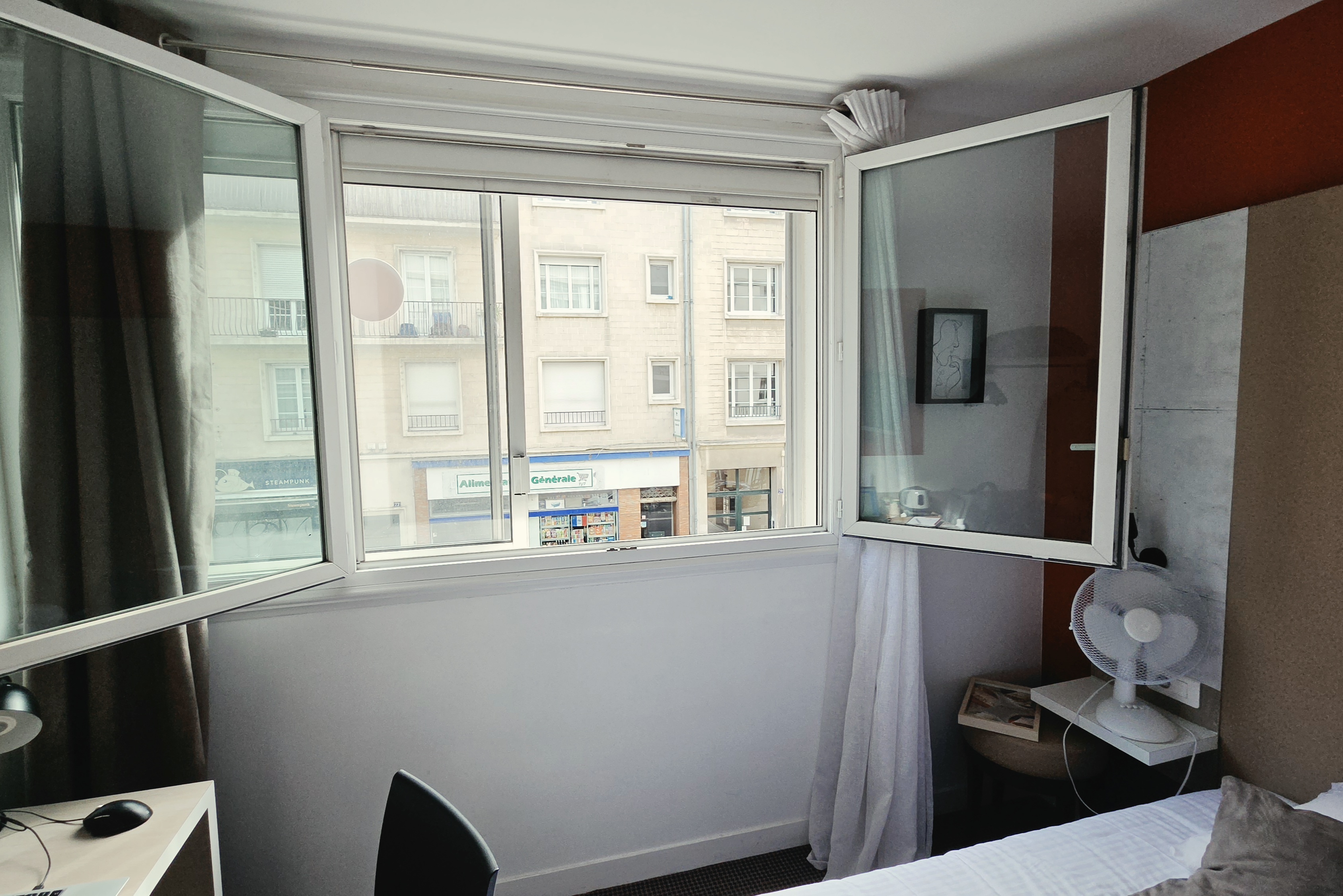
And you simply cannot get this view anywhere in the US:
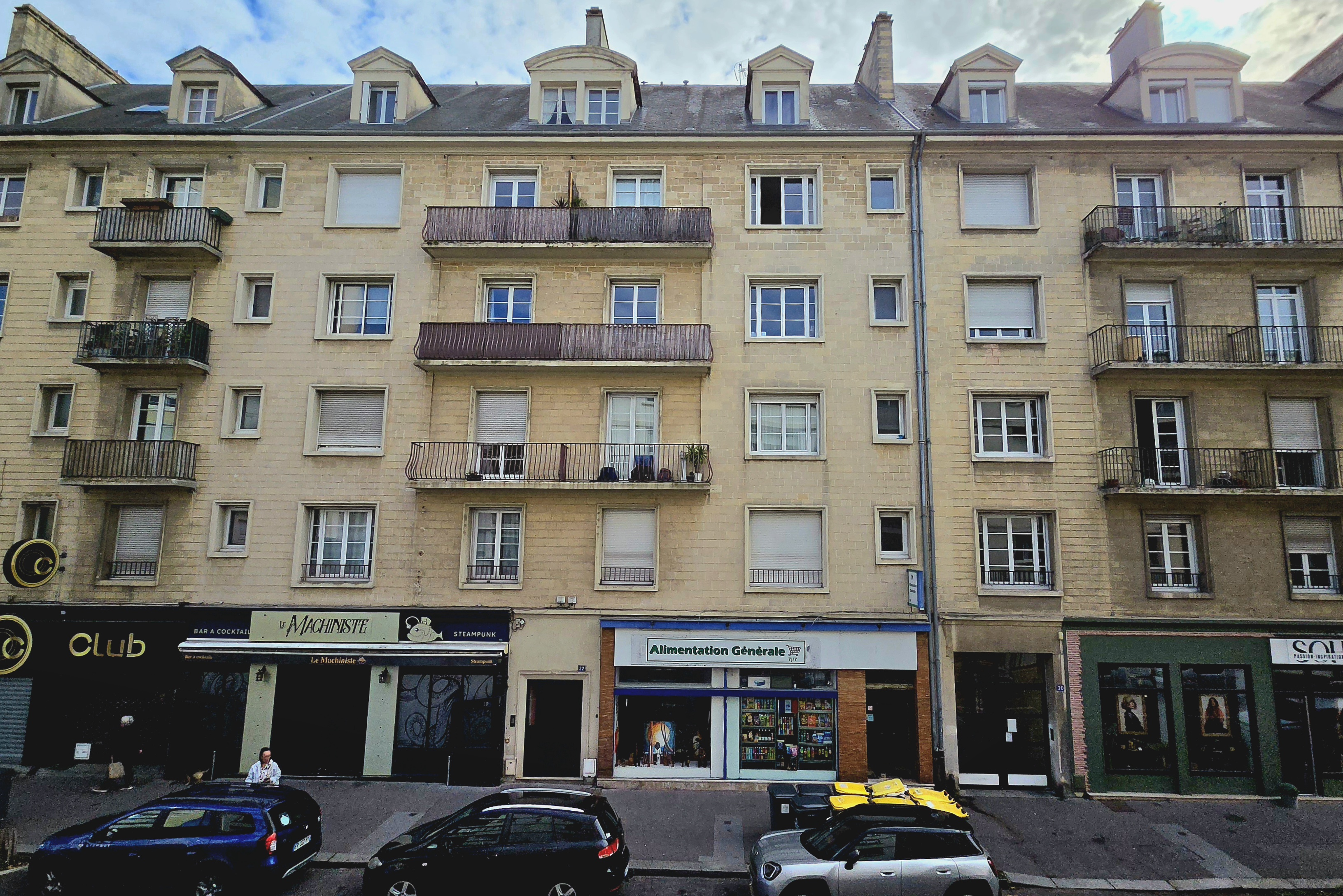
As I hope to spend no more than a handful of waking hours in the room, it'll do just fine. And tonight, it will get down to about 8°C, so this type of air conditioning will also be more than adequate.
By the way, Google was absolutely no help figuring out the bus schedule for tomorrow since it apparently doesn't understand that I have no objection to walking 2 km to catch a bus. Particularly if there is only one bus at noon and two buses in the evening that I can even take. Google got confused because the return bus stops in a different place than the outbound bus, so it didn't see them as the same bus. Fortunately, though I have never been to a rodeo, this is not my first time navigating France. (There are 9 trains to Bayeux after 6am that can get me to the bus going to the American Cemetery, and another half-dozen trains until 9:14 pm that can get me back to Caen.)
All right, I've confirmed that the room is fine, the internet works fine, and thanks to it being almost mid-September, the weather is great. I have absolutely no plans for the next five hours, so I will now do fuck-all.
I just passed through Paris traveling from Brussels to the Norman city of Caen. We're moving about 130 km/h through the suburbs, and we have wi-fi1. This is what happens when your country doesn't spend 90% of its transport funds on roadbuilding and instead invests in high-speed inter-city connections like we used to have in the US. </rant>
I'm happy to report that my French has been good enough that only one native French speaker has insisted on speaking with me in English in the last 24 hours, and that was OK because I had run aground on shoals of vocabulary. He did go back to French once I got unstuck.
I'll be using Caen as my base for the next two nights, then returning to London through Paris. The Normandy regional trains go in and out of Gare Saint-Lazare, about 2.4 km (1.5 miles) from Gare du Nord, where the Eurostar stops. I have almost two hours from my arrival at St Lazare Friday afternoon until my Eurostar leaves, and even with UK immigration and security, that's enough time to walk, if I have the stamina.
Next report from Normandy. The train gets in just after 4. This afternoon I plan to get situated in the hotel, spend an hour or so exploring the city center, then find a place to eat. The weather forecast for tomorrow looks amazing for my planned visit to Omaha Beach and the American Cemetery. À bientôt.
-
In fairness, the train's wi-fi isn't perfect, and apparently it's got a pretty strict quota. Also, Amtrak does have wi-fi on many trains, including most of the Midwest routes. Still, on the Eurostar from Brussels to Paris this morning I clocked the train at 290 km/h and I had unlimited wifi. Europe is 10 years ahead of the US already, even before dealing with the current administration slamming us into reverse without even using the clutch.↩
The rain that was forecast around 10 am started around 5 pm, shortly after I returned to my hotel room to catch up on a few things. In my wanderings today I did manage to get a a Liège waffle, but since I got it from right by the Mannekin Pis, the waffle came with a non-optional chocolate pissing boy:

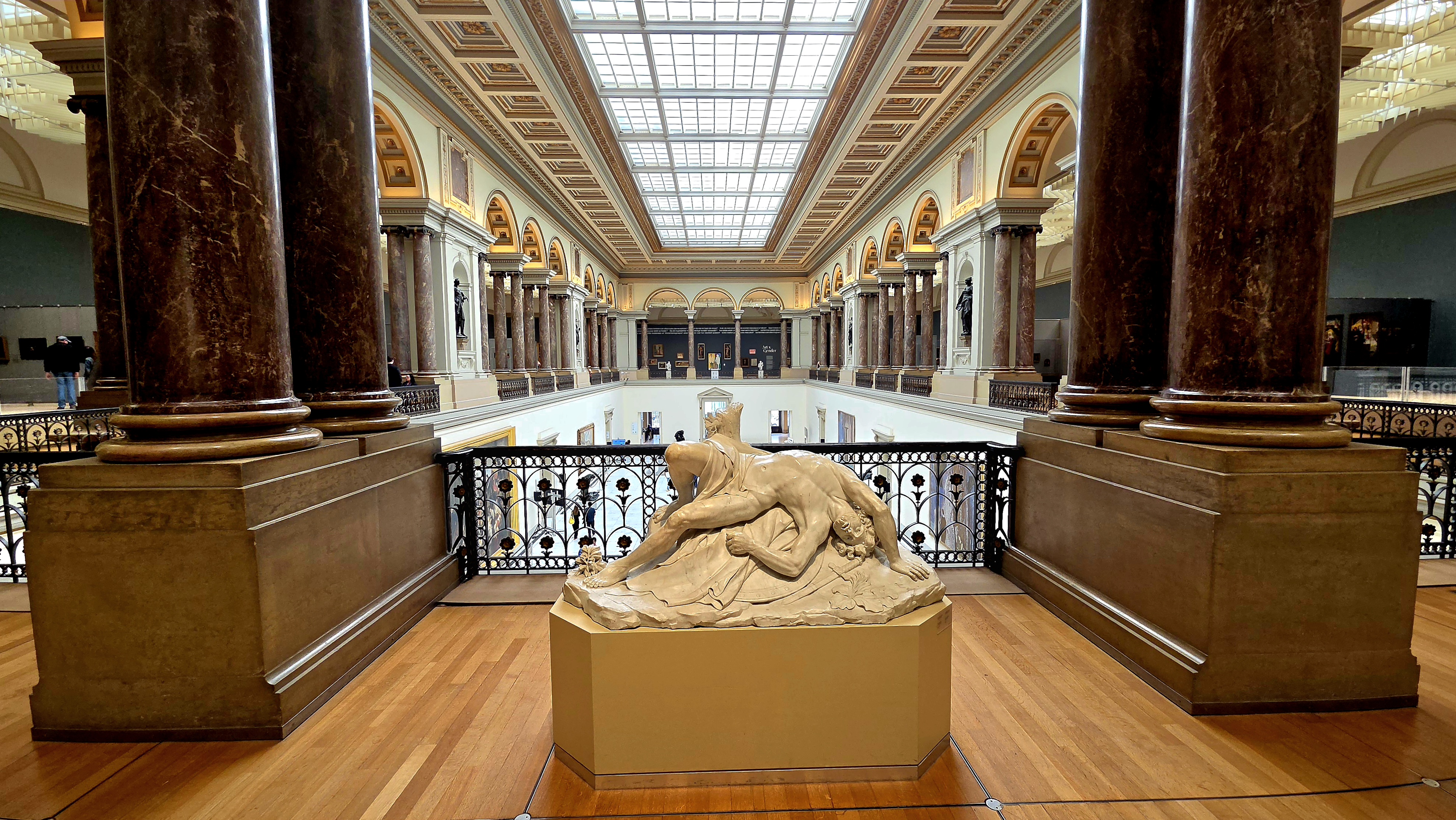
I finished the day aux musées royaux des Beaux-Arts du Belgique after having stopped by earlier. I spent €20 ($23) on a two-fer that included both the Magritte Museum and the Old Masters Museum, pictured below:
Right now I'm off to the Carrefour Express to grab water and possibly a snack. I've also picked out two possibilities for dinner, one French, the other Moroccan. One restaurant is 200 m away and the other is 800 m, so the choice will depend on how hard it's raining in an hour and a half.
Yesterday was a lot, especially since I hadn't completely recovered from traveling Saturday night through Sunday evening. Yesterday included a €60 fine for getting on the wrong train (more on that later); a 6 km hike from Aachen, Germany, to the Dreiländereck monument with a total climb over 150 m; two stops in Liège, Belgium; a climb up the Montagne de Bueren; a delicious plate of boulets à la Liégesoise; and several reminders of just how amazing European trains can be.
Two snapshots from Liège. First, the Liège-Guillemins railways station, designed by Spanish architect Santiago Calatrava in 2009:

Second, the aforementioned Montagne de Bueren, whose 374 steps took "only" six minutes and fourteen seconds to climb, but wow that was a long six minutes:
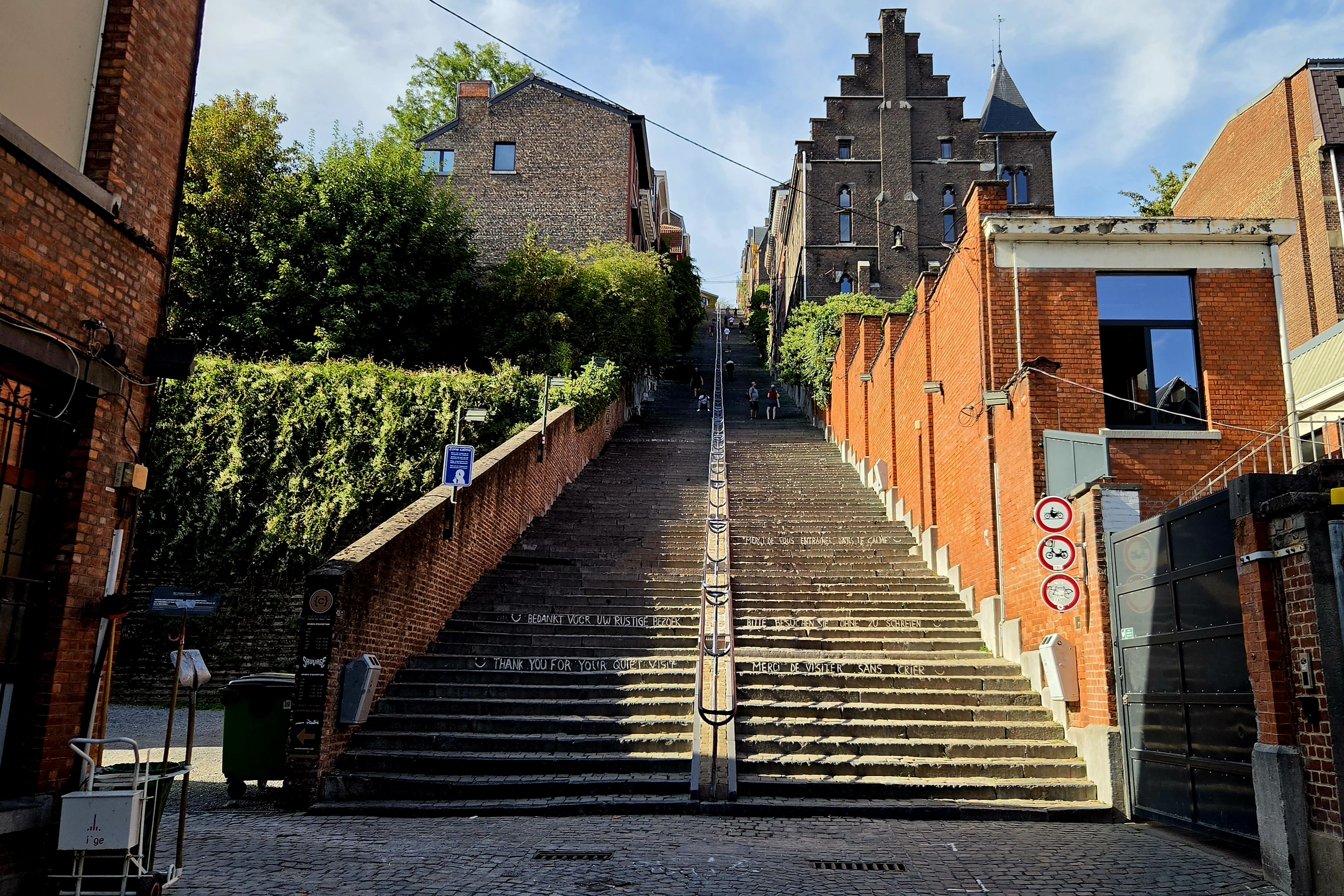
Today I don't plan to leave Brussels. The forecast predicts rain around 11, giving me just enough time to walk over to the Place des Musées where I have plans to learn more about René Magritte and fine art in general. And, most importantly, I will get a waffle.
I was in three countries today, all of them repeatedly, owing to a long hike I took from Aachen, Germany, to the Dreiländereck (three-country point). Then I went to Liège, and now I'm back in Brussels. I will recount all of these adventures with some preliminary photos at some point in the near future.
At the moment, I'm exhausted (completement épuisé), and I desperately need a shower.
À demain.
I am finally in my hotel room in Brussels after an only-slightly-delayed Eurostar from St Pancras. The only mistake I made was not realizing before I started walking to my hotel that it was 1.7 km uphill from the train station. Of course that means it's 1.7 km downhill on Wednesday when I next have to schlepp my bags. (It really earned its title "luggage" this evening.)
So far the hotel is fine. Free wi-fi, air conditioning, running water, and a bed. A bed that I am going to climb into just as soon as I shower, because it's warm (for Belgium) right now.
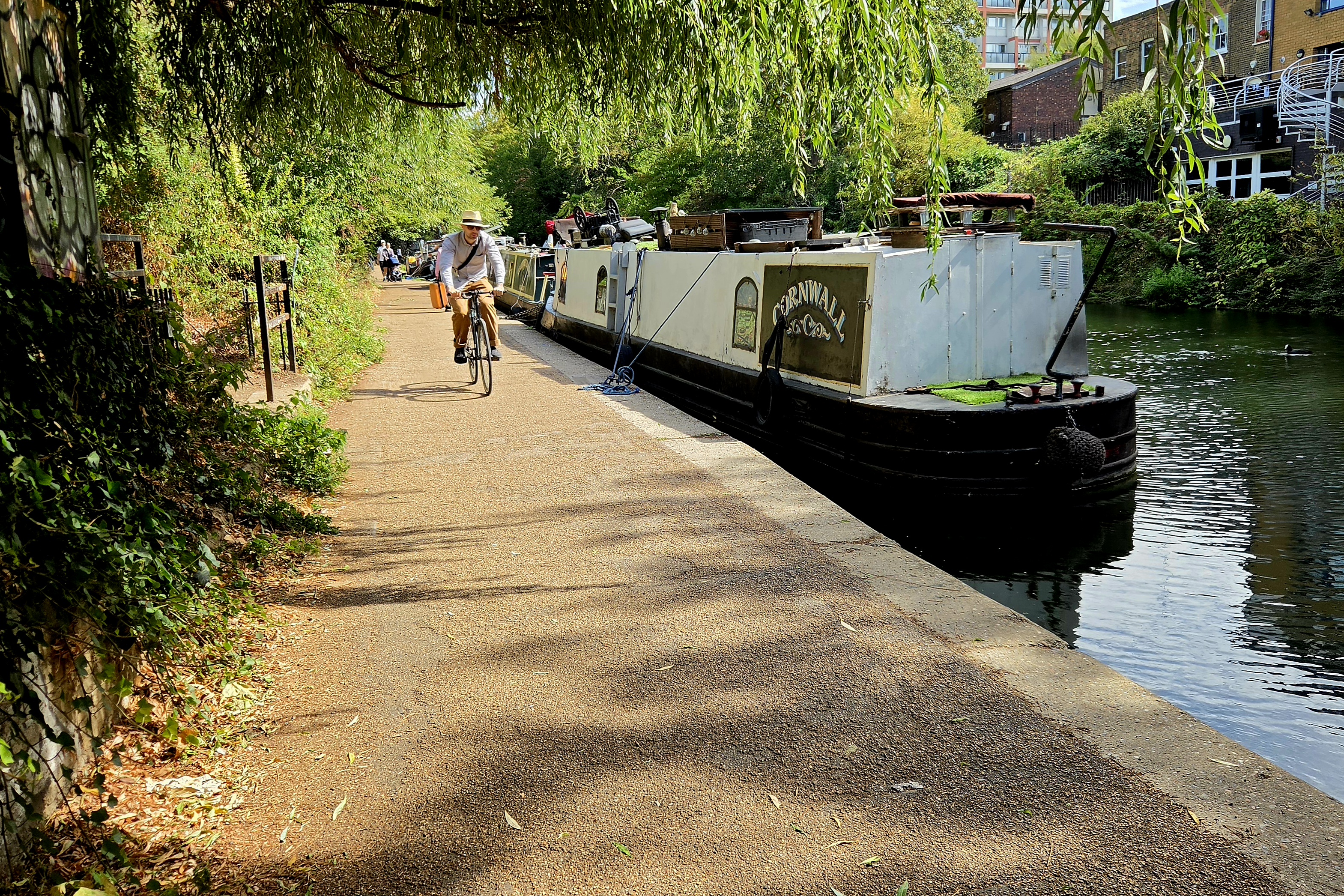
The hotel I'm staying in next weekend was able to keep my bags for a couple of hours so I could walk there, too in unusually beautiful weather. I walked along the Regent's Canal for a bit:
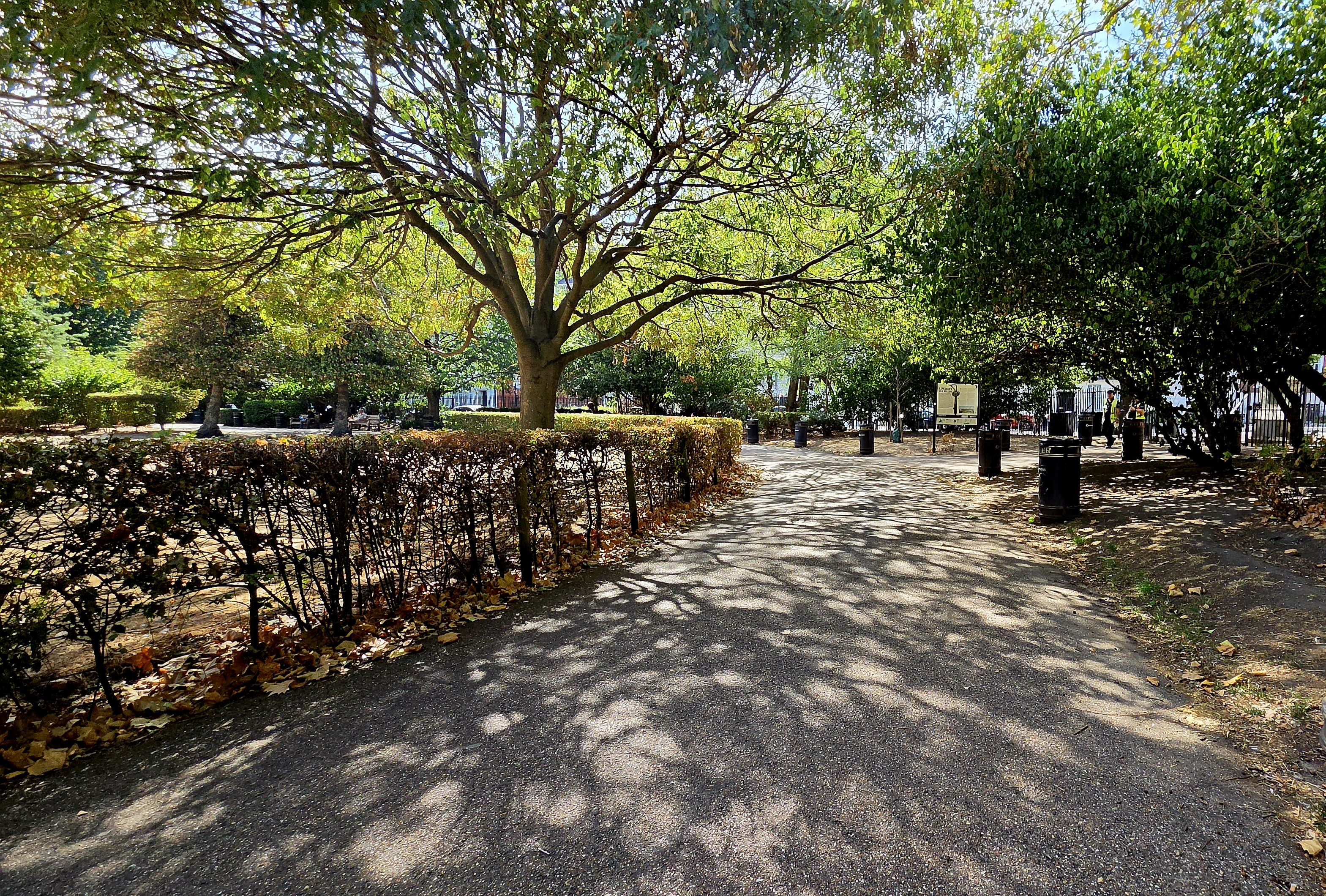
And wound up at Lincoln's Inn Fields where I sat on a bench for half an hour and read while the local crows and pigeons tried to figure out if I had anything for them:
All right, I'm on fumes right now. I'll pick this up tomorrow.
I was worried about the baggage retrieval system they've got at Heathrow when nothing happened for 15 minutes standing at the carousel. Once I checked to see where they had moved our bags, it was a quick trip to the arrivals lounge, a shower, and a cuppa. I really prefer this to the way I traveled the first time I got to the UK, schlepping a huge backpack around and not showering for something like 72 hours.
Now that I'm modestly caffienated, it's time to head to the Tube, thence St Pancras, thence my ultimate destination: Brussels. I sincerely hope that the hotel I'm staying at on the way back will let me stash my bag for a couple of hours, because Eurostar check-in isn't until just before 4pm. The weather is absolutely lovely today.
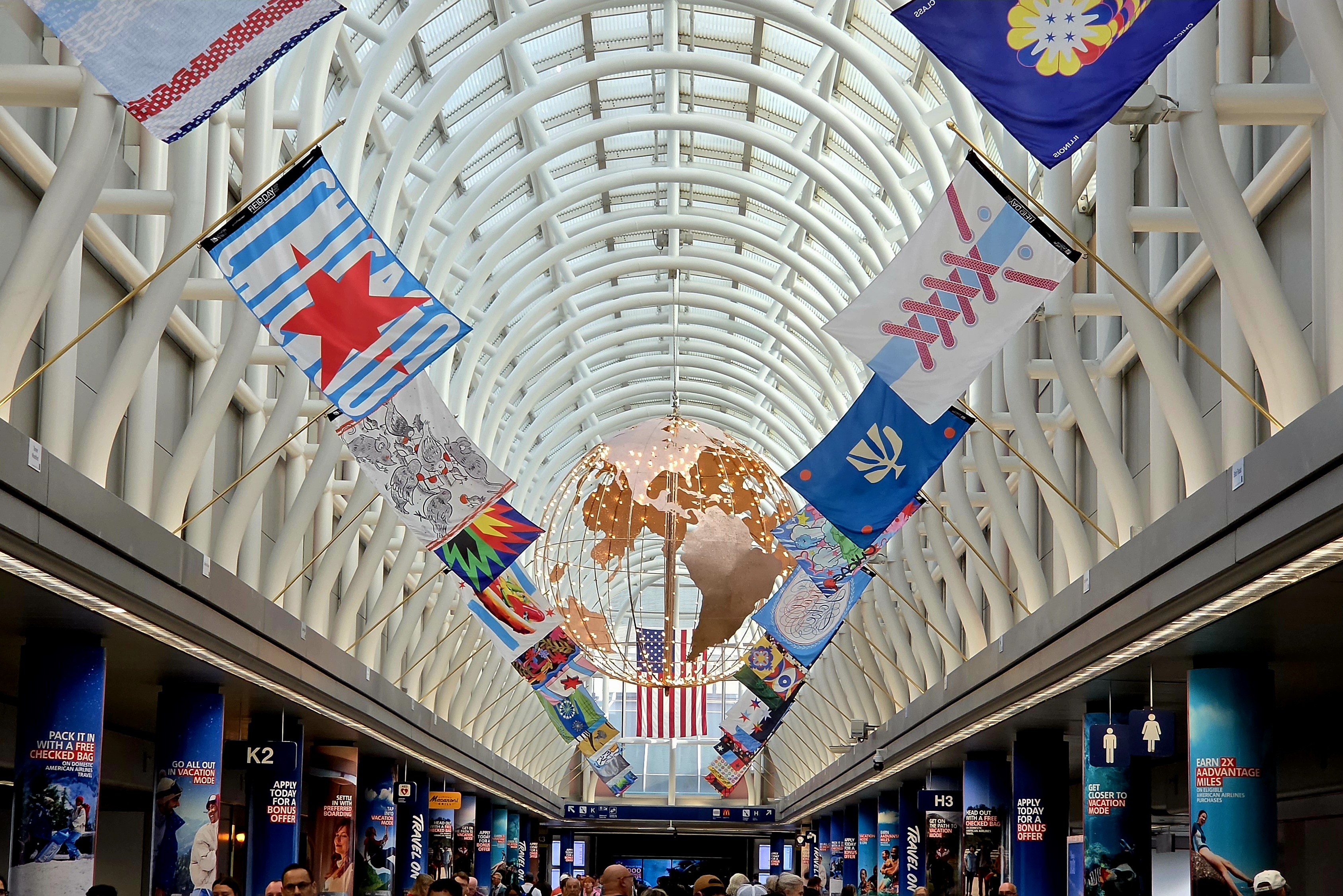
I'm sat quite peacefully in the American Airlines Flagship Lounge, sipping a Veuve Cliquot brut (n.v.), and tasting some of the new recipes they've got (the pesto balsamic salmon was lovely, but I think I'm going to get a bit more of the hoisin watermelon chicken). I'm also impressed with the current flag display in Terminal 3:
American still avers that my flight will depart on time, a claim I feel has some merit the plane appears to be sitting at the gate already. And I'm looking forward to a really nice flight. The airline sent me an email a couple of weeks ago inviting me to pre-order one of their centennial-inspired meals, and I admit I'm curious how flaky the crust on my beef Wellington will be at altitude. I'm optimistic.
I've got about 90 minutes to chill here before I need to rouse myself, so I'm finally reading a bunch of articles that I downloaded as .pdfs, including a 2021 FTC report on right-to-repair laws; the SCOTUS decision in Barbara v Trump, upholding the plain birthright-citizenship language of the 14th Amendment; and the score to a friend's new musical that I got a chance to see in workshop recently. (He's asked for "detailed notes," which is flattering given he's written three complete musicals and I've written a few motets and Mass movements.)
Next report will either be from London tomorrow morning, or from right here later tonight complaining about not getting to London tomorrow morning. I've got a Eurostar ticket at 5 pm, which is more than 6 hours after my plane is supposed to land at Heathrow. As confident as I am in American's ability to get me there in time, I am also a veteran of many, many years of air travel.
I have a mug that says, "Should I release at 5pm on a Friday?" "No!" "What if I just..." "OMFG no!"
And yet I've just released an update to this app that contains quite a bit of rearchitecture. So, I'm going to watch what happens over the next few days, and hope that it doesn't blow up while I'm on vacation. But there were a couple of things I really, really wanted in place before I traveled, so I took the risk.
Also, this is non-commercial software (for the time being), very much in active development. And all 622 unit and integration tests pass. Fingers crossed.
I woke up in a fog this morning:
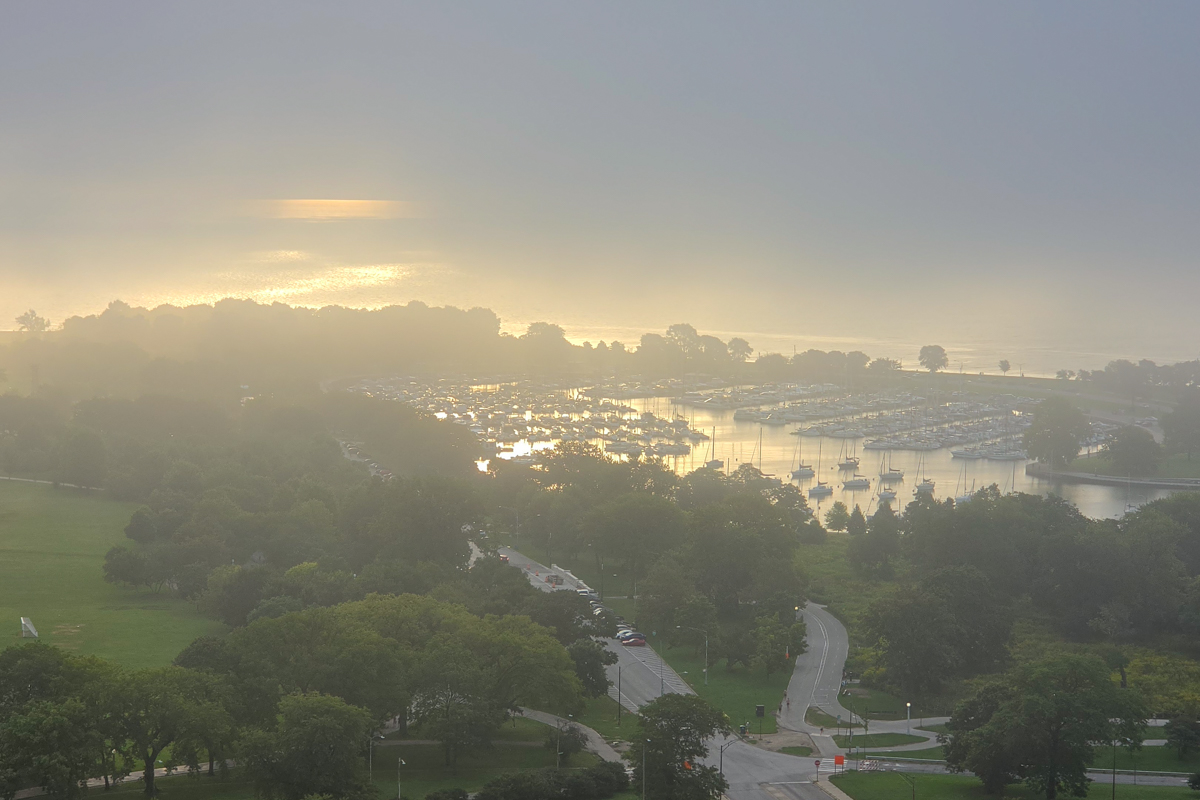
That hasn't stopped me from finishing up a new feature for this application, and from organizing everything necessary to start packing once I drop Cassie off at Butters' house. (I think she knows something is up...)
I should have a relatively easy time packing this afternoon. It's a late flight, scheduled to leave at 8:45 pm, which the airline currently claims will take off on time.
Next update this evening, either from the airport and happy, or from home and not.
Once again, Cassie and I got up obscenely early (5:30 am), but that allowed us to take a very long walk around the lake side of Belmont Harbor without needing sunscreen. It was 27°C with a 30°C heat index, however, but it was still pretty:

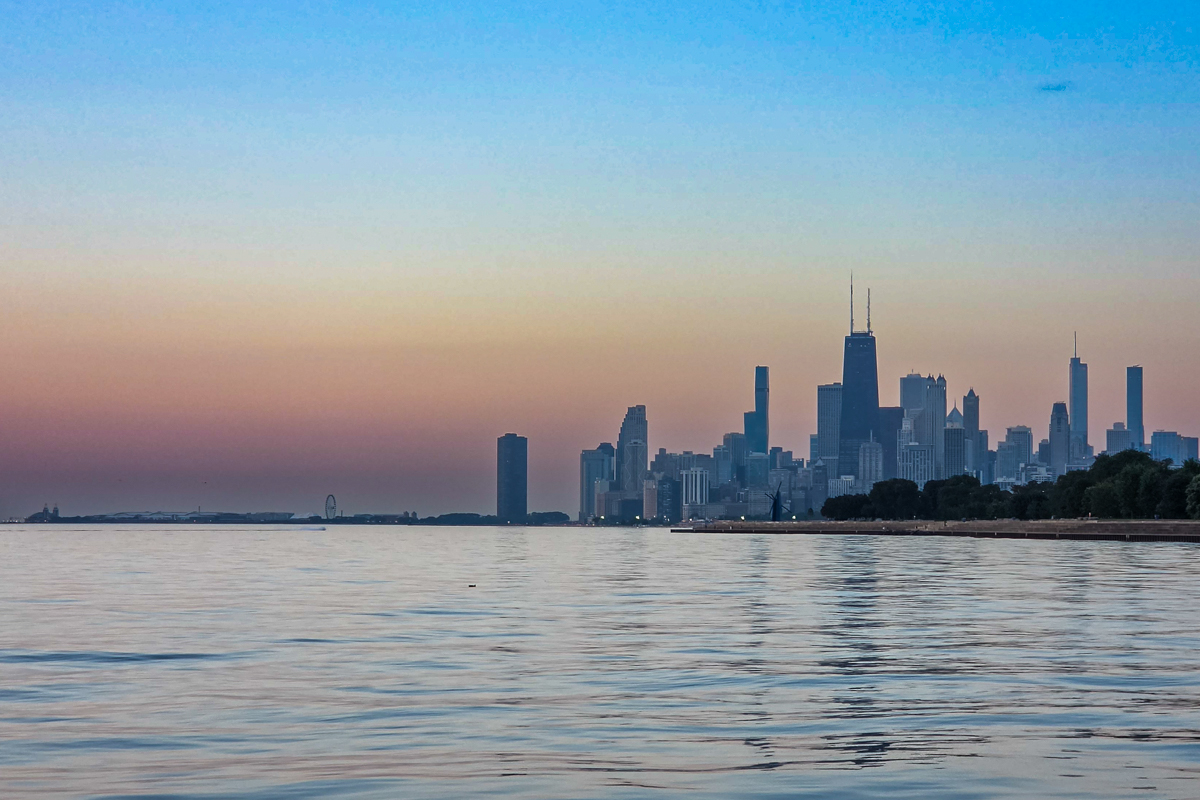
At the southern end of the peninsulette bordering the north side of the harbor (too precise?), there's an amazing view of the skyline and Navy Pier:
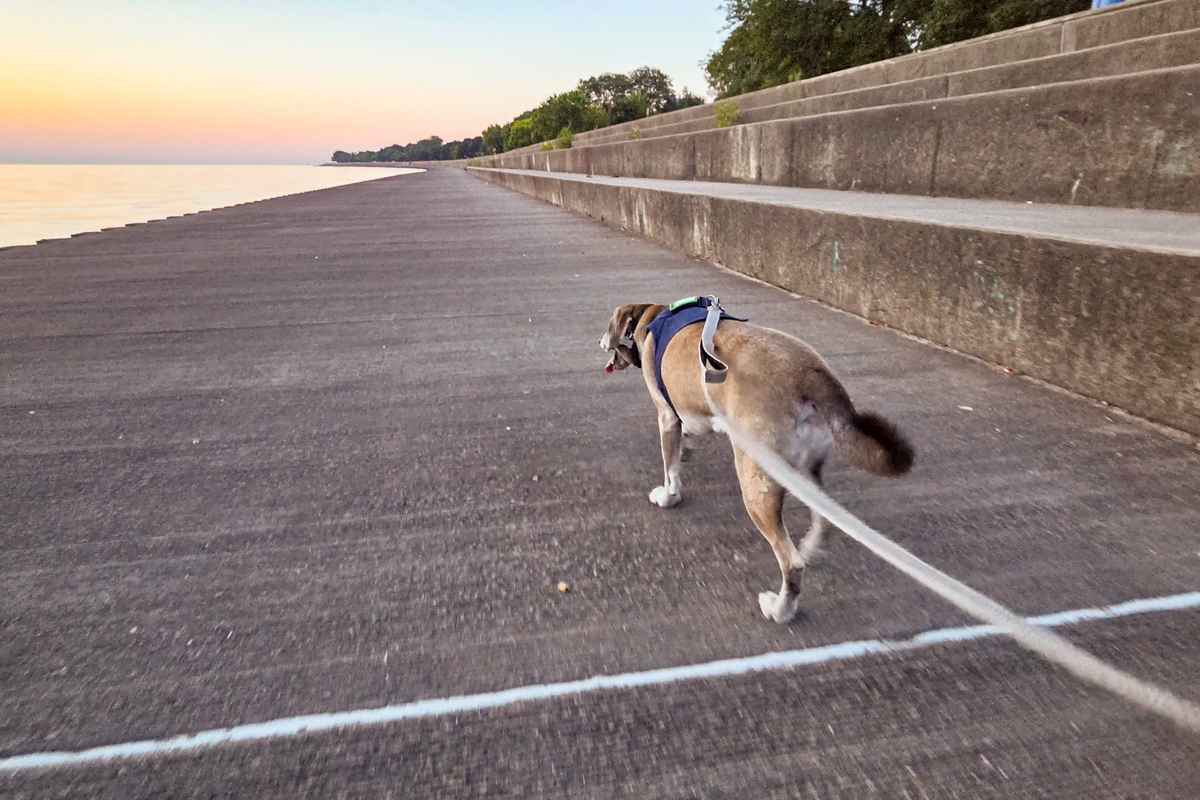
Cassie didn't care about either of those things, but she did enjoy the 55-minute walk and all the new smells:
I'm now applying updates to my travel laptop and drying my second load of laundry. Pre-travel days are always exciting. I'll hold off putting Cassie's food into bags until the last minute, though.
Google has gotten a lot of flak for updating their Maps product for US-based visitors to show a different name for Lake Ontario. Google made the change following an asinine Executive Order directing the Board on Geographic Names to update its database. That is the only thing the EO actually did, and, I am sad to report, it was an entirely lawful EO.
Here's the thing, though: Google updating its database to follow the BGN's is apolitical. It's the most neutral stance on the idocy they could have taken. I would bet you all the money in my pockets against all the money in your pockets that a majority of the people working on the Google Maps team think the name change was stupid, just like nearly everyone else in the world. But hand-editing the data update they received from BGN last week would represent a pretty serious deviation from their mission to stay out of domestic US politics.1
Blaming Google for the OAFPOTUS's tantrum and Interior Secretary Doug Burgum's boot licking is shooting the messenger. This deviation from how the BGN actually works2 (and the previous one) will be undone before the end of January 2029, along with thousands of other EOs that this kakistocracy has smeared on the republic over the past 20 months.
-
Please do not lecture me on how maps are inherently political. There's a pretty good chance I've been doing GIS work longer than you've known how to turn on a computer.↩
-
Except for these narrow exceptions, the BGN has a descriptive mission, not a proscriptive one. In other words, the US Gazetteer is a dictionary, not a rule book.↩
Cassie can't read a weather forecast
My dog is harrumphing on the couch, because despite already getting 52 minutes of walkies before 8 am, that was in the past and therefore no longer part of her consciousness anymore. The temperature is now almost 32°C with a 38°C heat index, however, so I am not in any hurry to go back out there. Nah, I'd rather feel uncomfortable indoors, reading stuff like this:
- Gloria Steinem has died at 92. The founder of Ms. and a journalist who began her career reporting undercover from the Playboy Mansion, Steinem was a feminist leader who helped bring about some measure of women's equality in the US.
- Ensuring that no one will continue wondering if the OAFPOTUS is a Russian asset any longer, Treasury Secretary Scott Bessent is now blaming Ukraine for high gas prices, rather than, you know, his boss starting an idiotic war with Iran.
- There is so much insider trading on prediction markets that even this administration is prosecuting it.
- The August 26th landslide that killed at least 1,000 people and destroyed thousands of structures in Nepal appears to have started with a bedrock collapse that may have been accelerated by global warming.
- It was so hot yesterday that two Chicago bridges got stuck open, including the Lake Shore Drive bridge over the river, snarling traffic across the city.
- The massive El Niño building in the Pacific presages a much-warmer-than-normal winter for the northern US and southern Canada, but "drier" does not mean "snow-free."
- The O'Hare Flyer committee have explained how redundancies will keep the thing reliable as critics struggle to understand how it is possible to build new railroad tracks.
- Cybersecurity firm Any.Run set a honeytrap for North Korean cybercriminals and found out a lot about how they operate.
OK, back to the mines. I have some new client work this afternoon and patch releases for The Daily Parker and Weather Now to get out before Saturday.
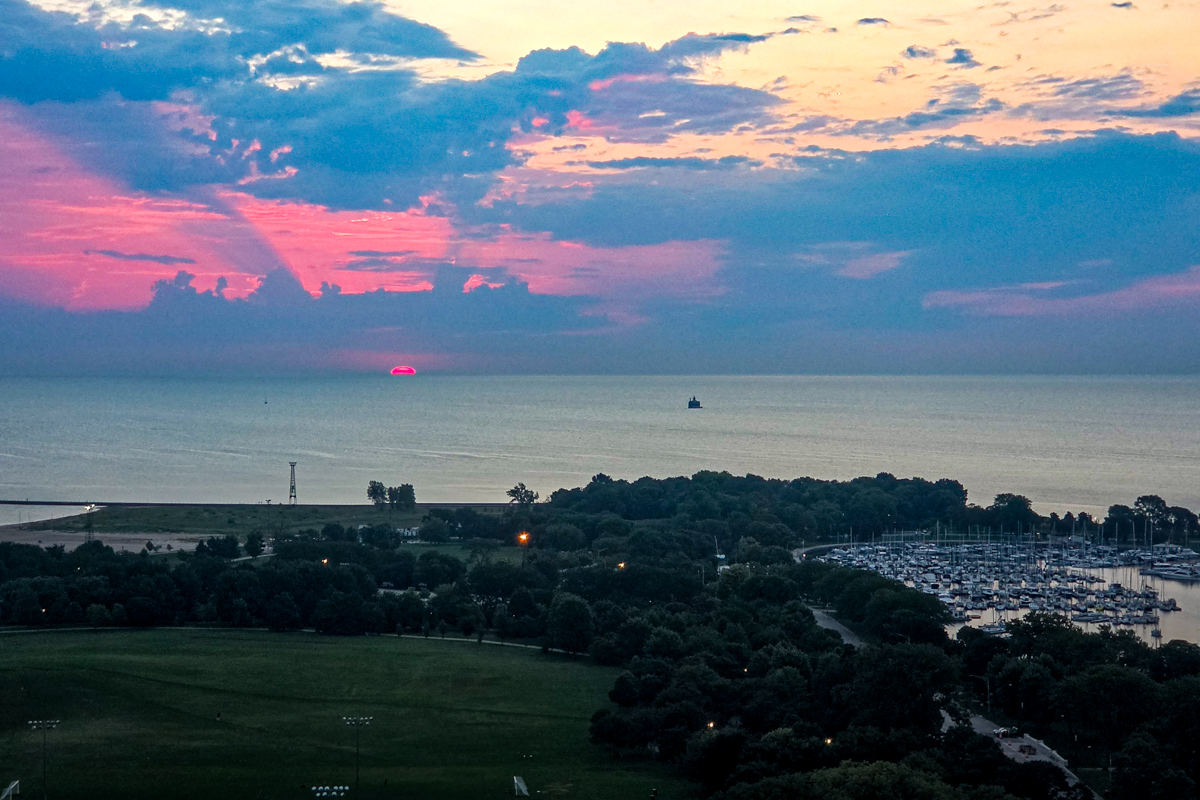
I got up about 15 minutes before sunrise this morning because I want to adjust my body clock by a couple of hours before stumbling off an airplane at Heathrow just after 4am Chicago time Sunday morning. I don't really like getting up before dawn under most circumstances, but today I got a sample of what I'll get to see most mornings from mid-September until the beginning of April:
Cassie certainly didn't mind getting out before 6:30 am either, despite the unpleasantly hot and sticky weather. And while she took care of her own urgent business just east of my building, I got a chance to snap a marketing photo for my landlord:
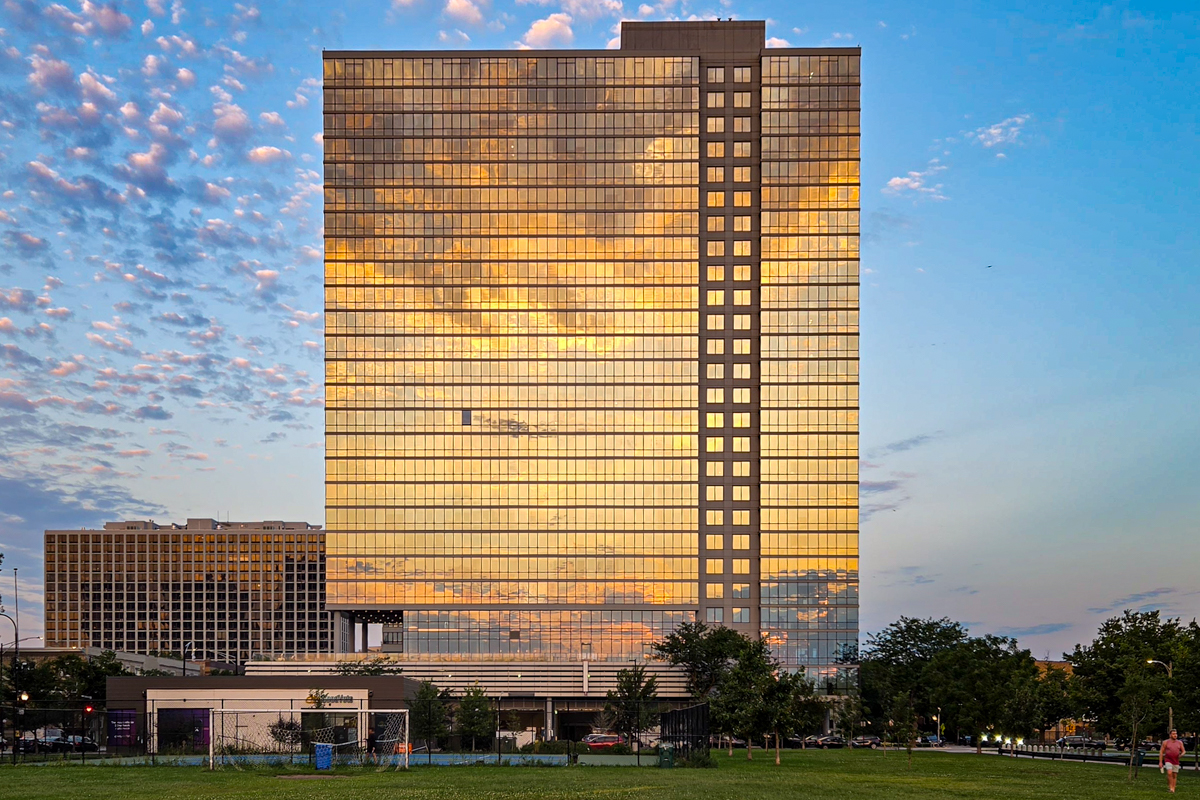
We then did a 5 km walk because neither of us will want to do much outside as the heat index creeps towards 42°C the rest of the day.
The temperature at O'Hare hit 35.6°C (96°F) this afternoon, tying the hottest temperature of the year (July 14th). Cassie has gotten an hour of walks today, but in 20-minute increments outside. I still feel icky.
Fortunately, the forecast calls for a cool front to move in tomorrow night, so even though it'll be 32°C tomorrow, it should coold down to 27°C Friday. Then Saturday night I'm taking off to my Ancestral Homeland and a couple of its neighbors where it looks to be a bit cooler: highs around 25°C and lows around 15°C all week. Except for a spot of rain, it should be perfect.
Closer to home, Crain's reported today on the trend for microbreweries to merge together rather than waiting to be snapped up by InBev or another mega-corp:
For much of the past two decades, craft beer has enjoyed unbridled growth. But after the pandemic, customers did not return to taprooms as expected. Retail beer sales sagged as people turned toward wine, spirits and canned cocktails, or cut back on alcohol consumption. The price of ingredients, like grain and aluminum cans, has skyrocketed. Craft breweries that took out big loans to survive the pandemic could not pay them back. Ten percent of Illinois’ roughly 300 craft breweries closed between 2022 and 2023.
Illinois’ craft brewers evolved to survive, and it is no longer just about the beer. They’ve rolled out non-alcoholic options, food menus and THC-infused beverages. They added food menus, and host regular events like trivia to get customers through the door. As breweries have closed, those that survived have moved into their vacated spots. The real estate sometimes comes with the brewing equipment, cutting down costs. More breweries are sharing spaces, to reduce fixed costs like rent.
Now, add mergers and acquisitions to that growing list of tactics meant to adapt the craft beer to its new economic reality.
Maplewood had production needs, and Half Acre had unused production capabilities. Now, Half Acre brews most of Maplewood’s beer. Maplewood is known for flagship beers such as Son of Juice IPA, Charlatan American pale ale and Pulaski Pils lager. Half Acre’s flagship beer is Daisy Cutter pale ale.
Pollyanna had four locations in the Chicago suburbs, but none in the city. It announced in July it bought Alarmist, which had closed its one location in the Sauganash neighborhood earlier this year. When Pollyanna reopens the Peterson Avenue spot this winter, it will add an event space and kitchen to its repertoire — two new revenue streams it currently does not offer at its other locations.
The Brews & Choos Project will get to a lot of those merged breweries. (Unfortunately the former Alarmist space is nowhere near a train, so I'll just have to visit it without a B&C review.)
I will not be having a cold beer tonight, however, because (a) it's really too hot for alcohol and (b) I'm dragging my body clock back a couple of hours before flying to Europe, to ease the time zone transition. More on that as the trip gets closer.
Chicago had 122 murders during meterological summer this year, the lowest number since 1965. And yet, most of the candidates for mayor can't help themselves:
Despite historically low levels of violent crime in Chicago this year, candidates trying to replace Mayor Brandon Johnson are sweeping aside the numbers in favor of anecdotes and are depicting the city as reeling in a “crisis” of gun violence and lawlessness.
Overall violent crime hit its lowest level last year in more than four decades. City data shows the downward trend has continued this year.
FBI-classified “index” crimes at CTA locations — trains, buses, stops and all other properties — are down 29% this year through Aug. 23, according to police figures. Seven categories, ranging from thefts to shootings, are all down. Two other categories increased: There were 24 sexual assaults and four arson incidents.
Businessman Willie Wilson’s campaign website says crimes, including smash-and-grab robberies and car thefts, “have shaken the foundation of our city.”
Chicago robberies last year were down more than 86% from their 1991 peak, according to annual Chicago police reports. More recent police data shows robberies falling sharply since a small surge in 2022 and 2023 that experts tied to the pandemic.
Perhaps this is why the stereotype of big cities having lots of crime persists: because making people afraid gets votes. But we had 90,000 crimes in 1991 and only 22,000 last year, which was the lowest number recorded in my lifetime. Last year's murder rate of 15.3 per 100,000 puts Chicago 27th on the list of cities by murder rate1, significantly below Birmingham, Ala. (58.85) and just a bit ahead of Syracuse (15.15). You want high crime rates? Go to red cities, my friend.
So it really annoys me that Chicago politicians, who know better, are sounding like Republicans about crime. Is homicide a problem in Chicago? Yes, particularly on the South Side. But take a look at the 1980s and 1990s and ask whether it might be heading in the right direction.
We should be absolutely crowing about the declining crime rate in Chicago, and celebrating a 61-year low in murders. We should also burn Thomas Midgley Jr in effigy every year to remind ourselves that our love of cars has killed untold millions of people, many through the violent crime that leaded gasoline may have caused2.
Bloody hot day in autumn
Even though the first day of September is also the first day of meterological autumn, in Chicago it usually feels more like July than October. Today is definitely a July day, with the heat index at O'Hare already almost 39°C. Cassie and I took our long walk this morning for that reason.
Elsewhere:
- Defense Secretary Pete Hegseth is doing what incompetents usually do: hiding his bad decisions from the press.
- Molly White outlines regulatory capture in the US crypto market, including a new 400-page proposed rule from the SEC that will make life a lot easier for cryptocurrency scammers.
- Speaking of scammers, the OAFPOTUS's plan to steal Venezuelan oil is not just awful foreign policy, it's also deeply stupid.
- A cache of training materials from
SovietRussian intelligence shows how the GRU and FSB are training the next generation of hackers at Bauman Moscow State Technical University. - Scammers have charged Chicago White Sox fans thousands of dollars for parking for years with no arrests.
- NIMBYs in River Forest, Ill., are throwing cold water on the O'Hare Flyer because they don't want passenger trains zipping through their leafy suburb.
Finally, my Brews & Choos buddy was at Wrigley Field yesterday watching the Cubs hit a record NINE home runs in their 17-3 slaughter of the Milwaukee Brewers. Her texts during the game were epic and, sadly, not repeatable here. Alex Bergman alone got 3 home runs for the second time in his career. The Cubs (78-60) are currently 7 games behind the Brewers (85-53) and tied with the Phillies for the wild card spot, with only 24 games left in the season. (The White Sox are 3 games ahead of Cleveland at 72-65, which hardly seems fair.)
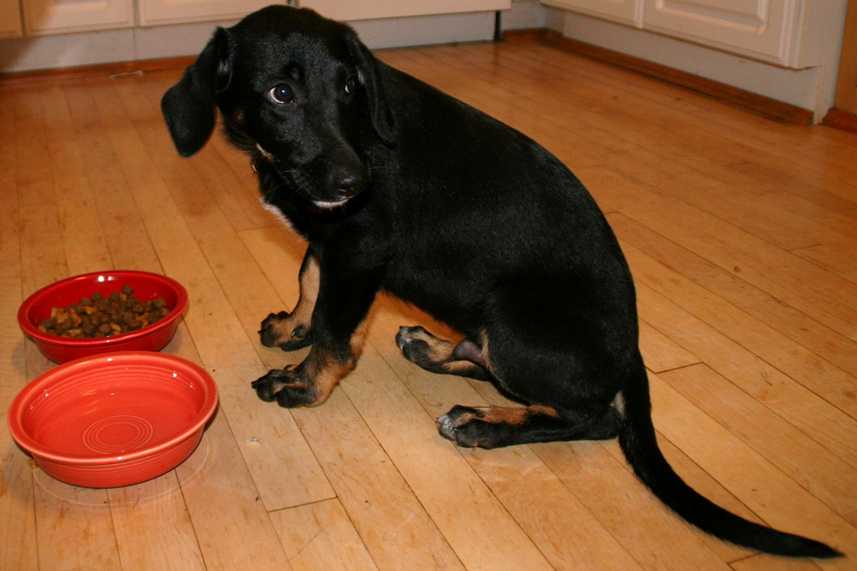
Hard to believe, this little guy followed me home 20 years ago today:
I pushed out two software releases this afternoon, one big and one small. It seemed fitting to do both on the last day of summer.
The big one is Weather Now v5.0.9740, which includes 22 Jira cases, most of them from the big architecture and performance review I conducted in July. I managed to get all of that work done in 16 hours over 11 days. Already I'm seeing real performance improvements and fewer error reports. The release also includes 12 Jira cases and 7 hours of work on the Gazetteer, which runs the geographical services the weather app depends on.
The smaller one is right here: Inner Drive Journal v1.0.9740, which just has a couple of minor bug fixes and tweaks that I discovered after the much bigger release two weeks ago.
These releases wrap up the big push to root out years of chuft that had built up throughout the Inner Drive ecosystem. They also clear the way for a bunch of incremental feature releases I have planned, some of which I've wanted to build for years. (There are a couple of Weather Now features that never made the leap from ASP to .NET in 2001, and I miss them.)
OK, I've already spotted a couple of nits to pick in the Calendar feature, so let me get back to it.
It's the end of the summer as we know it
We've had an unusually normal August so far, with not a single day above 32°C all month in Chicago. Oddly, Wednesday might hit 33°C, despite being, you know, the second day of Autumn and all. But that's also pretty normal around here; we really don't get our first blast of autumn cool until the third week of September most years.
- Continuing the OAFPOTUS's second term as the apotheosis of Republican efforts to let businesses steal and pollute as much as they want, Russell Vought's idea of enforcing consumer protections is to "politely ask companies to behave," with predictable results.
- Speaking of ripping people off, is it any surprise that the owners of the "freedom fuel" gas stations may have stolen $4 m worth of gas to make their "discount" scheme work? It's not, if you've ever paid attention to how the OAFPOTUS and his droogs do business.
- Matthew Yglesias argues that Democrats should campaign on surrendering to the Canadians in this asinine trade war the OAFPOTUS started.
- It's not that pro-democracy Americans are opposed to resistance against the OAFPOTUS, Brian Beutler writes; they just want one that works.
- The fact that Republicans want a Constitutional amendment fixing the size of the Supreme Court at 9 tells you that we absolutely must increase its size to 13 as soon as we can.
- You know one of the best ways to cut our national debt? Collect the $600 billion in taxes that the super-rich are evading each year.
- A pro se plaintiff in Connecticut seeded his complaint with AI prompts in hopes of swaying the litigation, and the judge in the case was not amused.
- US District Judge Nancy Brasel (an OAFPOTUS appointee!) has ruled that professionals have First Amendment protections when advocating against their licensing agencies, in a big win for Strong Towns executive director Charles Marohn.
- United Airlines wants to dominate O'Hare the way American dominates Dallas-Fort Worth, which is a bad idea for everyone.
Ah, such light and happy news for the last day of summer!
Actually, I do have some light and happy news: I plan to push two software releases into production this afternoon. Stay tuned.
Copyright ©2026 Inner Drive Technology. Privacy. Donate!